
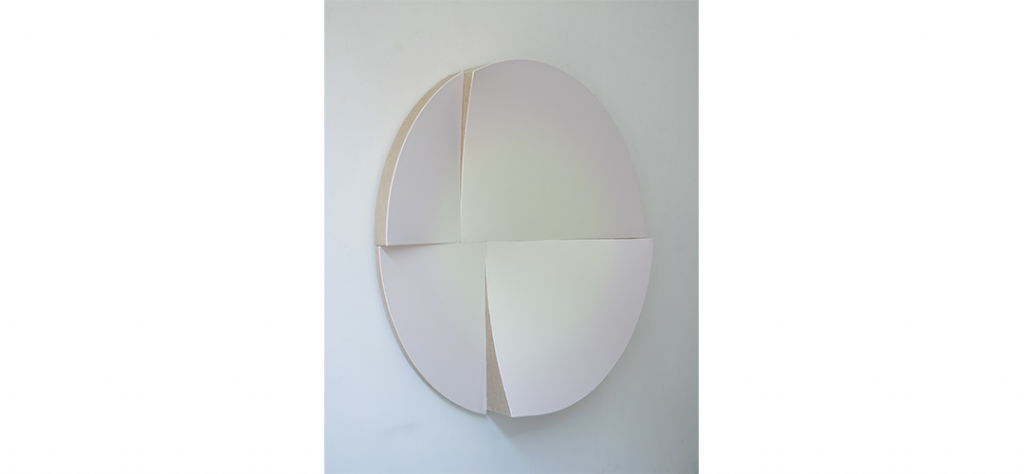
Jan Maarten Voskuil
Pointless Magnolia IV
Acrylics on linen
diameter 115cm
2023
Jan Maarten Voskuil (Arnhem, the Netherlands, 1964) stretches his paintings into the third dimension. His crafted, partly curved wooden constructions are based on simple geometric principles: the circle, the square, and the rectangle He stretches the frames with linen and usually paints them in monochrome colors. With a minimum of means, he manages to develop a broad spectrum with his work whereby he partly stands in the tradition of the constructive, minimal, and concrete art of the twentieth century.
His work is labeled as spatial object, sculpture, autonomous design or even architecture. He himself consistently continues to call the work painting because his frame of reference is painting. Spatial or not, "It remains paint on canvas, and deals with the limitations of the flat surface," he argues. "Conversely, you would call Carl Andre's work sculpture even though it's mostly flat, wouldn’t you?"
Still, there is something to be said for seeing in Voskuil not just a painter. Over the years, his ingenious stretchers have become primarily modular constructions, which can sometimes be assembled in various ways. This makes him not only a painter but also a "builder" of paintings, which brings him very close to architecture.
In his latest series of works the exploration of space is accompanied by the (re)introduction of emptiness into the painting. The modules are no longer connected to each other. Although this disintegration already made its appearance in the series Dynamic Monochromes, from 2012 onwards, in the form of indentations between the modules, this in-between space, like the cuts, is now much more thematized. A second recent development is the introduction of color gradients. This represents a dramatic break with the monochromy of his work so far. It is as if he is embracing painting once more, rather than breaking it down.
Pointless Magnolia IV is one of Jan Maarten Voskuil's most recent paintings. The use of gradients was initially an attempt to suggest space by painterly means. By applying this to his work, which already possesses concrete space, he intended a double perspective and unfathomable depth. What pleased him most, however, was not the formal experiment, but the result that was reminiscent of the gradient of color as it is vividly present in flowers. An unintended effect, but chance findings are often the most beautiful.